Friday, 15 July 2016

Download Backtrack 5r3 Free - Latest (32 & 64 Bit)

Download Backtrack 5r3 Free - Latest (32 & 64 Bit)

BackTrack 5 R3 is one of the Most Powerful Linux Distribution used for Penetration and Find Loopholes in Websites, Software and Application. Basically, it is Based on GNOME Linux Distribution and Include many of Top used Security Tools Like MetaSploit, Wireshark, AirCrack, Nmap and other Digital Forensic Tools. BackTrack 5 R3 is Developed by Offensive Securities and Soon They are Stop BackTrack Linux Series. The Last Edition of this Operating System is BackTrack 5 R3 and Further They Starting a new Project that is also a Newest Version of This Operating System Known as Kali Linux. It is the Successor of Backtrack 5 R3 and Include all the Tools that you have in BackTrack 5 R3. BackTrack is also Found as Best Operating System Used by Hackers.

There are Millions of Security Researchers (White Hat) who use BackTrack 5 R3 for Digital Forensics, Testing Systems, Networks and Other Penetration work. But On the Other Hand, It is also the Favourite Operating System Picked by Hackers because of their Tools and Features. Hackers and Crackers use this Operating System, not For Testing Instead to Breaking Systems, Cracking Passwords, Hacking Accounts and other Notorious Work. BackTrack have all the Deadly Tools and Programs that you need to Break the Digital Systems. The Last Edition of BackTrack 5 R3 is released on August 13, 2012. After that, They Start Project Kali.

Features of BackTrack 5 R3:

Available in Different Flavours.Include all Hacking Tools.Preinstalled Digital Forensics.Simple and Easy Interface.Open Source for All People World Wide.Preinstalled Drivers.

What is hacking ?

What is Hacking

Hacking is the practice of gaining the unauthorized aceess of a system, in order to viewing, editing, copying the information or to accomplish a goal outside of the creator's original purpose. The person who is consistently engaging in hacking activities is called a hacker.


Hacker is a term used by some to mean "a clever programmer" and by others, especially those in popular media, to mean "someone who tries to break into computer systems.

Why do hackers hack ?

Just for funTo show offNotify many people their thoughtsSteal important informationTo destroy enemy's computer network

Hacking Examples

Vladimir Levin hacks Citibank Russian crime ring leader Vladimir Levin managed to gain access to accounts located in the Citibank network and stole millions of dollars in 1995.

Jonathon James hacks NASA Jonathon James was 16 when, in 1999, he hacked into NASA, and downloaded proprietary software and informations

Advantages of Hacking

Can be used to recover lost information where the computer password has been lost.  Teaches you that no technology is 100% secure.  To test how good security is on your own network.  They call it white hat computer hacking.

Disadvantages of Hacking

Criminals  It can use it to their advantage. can harm someone's privacy  It's Illegal

Types of Hacking

Types of Hacking

Website hackingNetwork hackingEthical hackingEmail HackingOnline banking hackingComputer hacking

Website hacking

Hacking a website means taking control from the website owner to a person who hacks the website.

Network Hacking

Network Hacking is generally means gathering information about domain by using tools like Telnet, Ns look UP, Ping, Tracert, Netstat, etc… over the network.

Ethical Hacking

Ethical hacking is where a person hacks to find weaknesses in a system and then usually patches them..

Email Hacking

Email hacking is illicit access to an email account or email correspondence.

Password Hacking

Password Hacking Password cracking is the process of recovering secret passwords from data that has been stored in or transmitted by a computer system.

Online Banking Hacking

Online banking Hacking Unauthorized accessing bank accounts without knowing the password or without permission of account holder is known as Online banking hacking.

Computer Hacking

Computer Hacking is when files on your computer are viewed, created, or edited without your authorization.

The Types of Hackers

The Types of Hackers

White hat hackerBlack hat hackerGrey hat Hacker

White hat hacker

A white hat hacker is a computer and network expert who attacks a security system on behalf of its owners or as a hobby, seeking vulnerabilities that a malicious hacker could exploit. Instead of taking malicious advantage of exploits, a white hat hacker notifies the system's owners to fix the breach before it is can be taken advantage of.

Black hat hacker

A black hat is a person who compromises the security of a computer system without permission from an authorized party, typically with malicious intent. A black hat will maintain knowledge of the vulnerabilities and exploits they find for a private advantage, not revealing them to the public or the manufacturer for correction

Grey hat Hacker

A grey hat is a skilled hacker who sometimes will act legally and other times may not. They are a cross between white hat and black hat hackers. They usually do not hack for personal gain or have malicious intentions, but may or may not occasionally commit crimes during the course of their technological exploits.

How to become a Hacker

How to become a Hacker

Hacking is an engaging field but it is surely not easy. To become a hacker one has to have an attitude and curiosity of learning and adapting new skills. You must have a deep knowledge of computer systems, programming languages, operating systems and the journey of learning goes on and on.

Some people think that a hacker is always a criminal and do illegal activities but they are wrong. Actually many big companies hire hackers to protect their systems and information and are highly paid. here is the list of most important steps necessary to become a hacker, have a deeper look

Steps:

Learn UNIX/LINUX

NUNIX/LINUX is an open source operating system which provides better security to computer systems. It was first developed by AT&T in Bell labs and contributed a lot in the world of security. You should install LINUX freely available open source versions on your desktops as without learning UNIX/LINUX, it is not possible to become a hacker. .

Code in C language

C programming is the base of learning UNIX/LINUX as this operating system is coded in C programming which makes it the most powerful language as compared to other programming languages. C language was developed by Dennis Ritchie in late 1970’s. To become a hacker you should master C language.

Code in more than one Programming Language

It is important for a person in the hacking field to learn more than one programming. There are many programming languages to learn such as Python, JAVA, C++. Free eBooks, tutorials are easily available online.

Learn Networking Concepts

Another important and essential step to become a hacker is to be good at networking concepts and understanding how the networks are created. You need to know the differences between different types of networks and must have a clear understanding of TCP/IP and UDP to exploit vulnerabilities (loop holes) in system. Understanding what LAN, WAN, VPN, Firewall is also important. You must have a clear understanding and use of network tools such as Wireshark, NMAP for packet analyzing, network scanning etc.

Learn More Than One Operating Systems

It is essential for a hacker to learn more than one operating system. There are many other Operating systems apart from Windows, UNIX/LINUX etc. Every system has a loop hole, hacker needs it to exploit it.

Learn Cryptography

To become a successful hacker you need to master the art of cryptography. Encryption and Decryption are important skills in hacking. Encryption is widely done in several aspects of information system security in authentication, confidentiality and integrity of data. Information on a network is in encrypted form such as passwords. While hacking a system, these encrypted codes needs to be broken, which is called decryption.

Learn more and more about hacking

Go through various tutorials, eBooks written by experts in the field of hacking. In the field of hacking, learning is never ending because security changes every day with new updates in systems.

Experiment A Lot

After learning some concepts, sit and practice them. Setup your own lab for experimental purpose. You need a good computer system to start with as some tools may require powerful processor, RAM etc. Keep on Testing and learning until you breach a system.

Write Vulnerability (Loop hole program)

Vulnerability is the weakness, loop hole or open door through which you enter the system. Look for vulnerabilities by scanning the system, network etc. Try to write your own and exploit the system.

Continue never ending Learning

Learning is the key to success in the world of hacking. Continuous learning and practicing will make you the best hacker. Keep yourself updated about security changes and learn about new ways to exploit systems.

Join Discussions and meet hackers

Most important for a hacker is to make a community or join forums, discussions with other hackers worldwide, so that they can exchange and share their knowledge and work as a team. Join Facebook groups related to hacking where you can get more from experts.

Best Hacker Movies

Best Hacker Movies

Here is the list of best hacking movies

Anti TrustDieHardHackersItalian JobPiratesSword FishTornWar Game

How to hack a Web Server

Customers usually turn to the internet to get information and buy products and services. Towards that end, most organizations have websites.Most websites store valuable information such as credit card numbers, email address and passwords etc. This has made them targets to attackers. Defaced websites can also be used to communicate religious or political ideologies etc.

In this article, we will introduce you toweb servers hacking techniques and how you can protect servers from such attacks.

Web server vulnerabilities

A web server is program that stores files (usually web pages) and makes them accessible via the network or internet. A web server requires both hardware and software. Attackers usually target the exploits in the software to gain authorized entry to the server. Let’s look at some of the common vulnerabilities that attackers take advantage of.

Default settings– These settings such as default user id and passwords can be easily guessed by the attackers. Default settings might also allow perform certain tasks such as running commands on the server which can be exploited.Misconfigurationof operating systems and networks – certain configuration such as allowing users to execute commands on the server can be dangerous if the user does not have a good password.Bugs in the operating system and web servers– discovered bugs in the operating system or web server software can also be exploited to gain unauthorized access to the system.

In additional to the above mentioned web server vulnerabilities, the following can also led to unauthorized access

Lack of security policy and procedures– lack of a security policy and procedures such as updating antivirus software, patching the operating system and web server software can create security loop holes for attackers.

Types of Web Servers

The following is a list of the common web servers

Apache– This is the commonly used web server on the internet. It is cross platform but is it’s usually installed on Linux. Most PHP websites are hosted on apache servers.Internet Information Services (IIS)– It is developed by Microsoft. It runs on windows and is the second most used web server on the internet. Most asp and aspx websites are hosted on IIS servers.Apache Tomcat – Most Java server pages (jsp) websites are hosted on this type of web server.Other web servers – These include Novell's Web Server and IBM’s Lotus Domino servers.

Types of Attacks against Web Servers

Directory traversal attacks– This type of attacks exploits bugs in the web server to gain unauthorized access to files and folders that are not in the public domain. Once the attacker has gained access, they can download sensitive information, execute commands on the server or install malicious software.

Denial of Service Attacks– With this type of attack, the web server may crash or become unavailable to the legitimate users.Domain Name System Hijacking – Withthis type of attacker, the DNS setting are changed to point to the attacker’s web server. All traffic that was supposed to be sent to the web server is redirected to the wrong one.Sniffing– Unencrypted data sent over the network may be intercepted and used to gain unauthorized access to the web server.Phishing– With this type of attack, the attack impersonates the websites and directs traffic to the fake website. Unsuspecting users may be tricked into submitting sensitive data such as login details, credit card numbers etc.Pharming– With this type of attack, the attacker compromises the Domain Name System (DNS) servers or on the user computer so that traffic is directed to a malicious site.Defacement– With this type of attack, the attacker replaces the organization’s website with a different page that contains the hacker’s name, images and may include background music and messages.

Effects of successful attacks

An organization’s reputation can be ruinedif the attacker edits the website content and includes malicious information or links to a porn websiteThe web server can be used to install malicious software on users who visit the compromised website. The malicious software downloaded onto the visitor’s computer can be a virus, Trojan or botnet software etc.Compromised user data may be used for fraudulent activitieswhich may lead to business loss or lawsuits from the users who entrusted their details with the organization

Web server attack tools

Some of the common web server attack tools include;

Metasploit– this is an open source tool for developing, testing and using exploit code. It can be used to discover vulnerabilities in web servers and write exploits that can be used to compromise the server.MPack– this is a web exploitation tool. It was written in PHP and is backed by MySQL as the database engine. Once a web server has been compromised using MPack, all traffic to it is redirected to malicious download websites.Zeus– this tool can be used to turn a compromised computer into a bot or zombie. A bot is a compromised computer which is used to perform internet based attacks. A botnet is a collection of compromised computers. The botnet can then be used in a denial of service attack or sending spam mails.Neosplit – this tool can be used to install programs, delete programs, replicating it etc.

How to avoid attacks on Web server

An organization can adopt the following policy to protect itself against web server attacks.

Patch management– this involves installing patches to help secure the server. A patch is an update that fixes a bug in software. The patches can be applied to the operating system and the web server system.Secure installation and configuration of the operating systemSecure installation and configuration of the web server softwareVulnerability scanning system– these include tools such as Snort, NMap, Scanner Access Now Easy (SANE)Firewalls can be used to stop simple DoS attacks by blocking all traffic coming the identify source IP addresses of the attacker.Antivirus software can be used to remove malicious software on the serverDisabling Remote AdministrationDefault accounts and unused accounts must be removedfrom the systemDefault ports  & settings (like FTP at port  21) should be changed to custom port & settings (FTP port at 5069)

Hacking Activity: Hack a WebServer

In this practical scenario, we are going to look at the anatomy of a web server attack. We will assume we are targeting www.techpanda.org. We are not actually going to hack into it as this is illegal. We will only use the domain for educational purposes.

What we will need

A target www.techpanda.orgBing search engineSQL Injection toolsPHP Shell, we will use dk shell http://sourceforge.net/projects/icfdkshell/

Information gathering

We will need to get the IP address of our target and find other websites that share the same IP address.

We will use an online tool to find the target’s IP address and other websites sharing the IP address

Enter the URL http://www.yougetsignal.com/tools/web-sites-on-web-server/ in your web browserEnter www.techpanda.org as the target

Click on Check buttonYou will get the following results


Based on the above results, the IP address of the target is 69.195.124.112

We also found out that there are 403 domains on the same web server.

Our next step is to scan the other websites for SQL injection vulnerabilities. Note: if we can find a SQL vulnerable on the target, then we would directly exploit it without considering other websites.

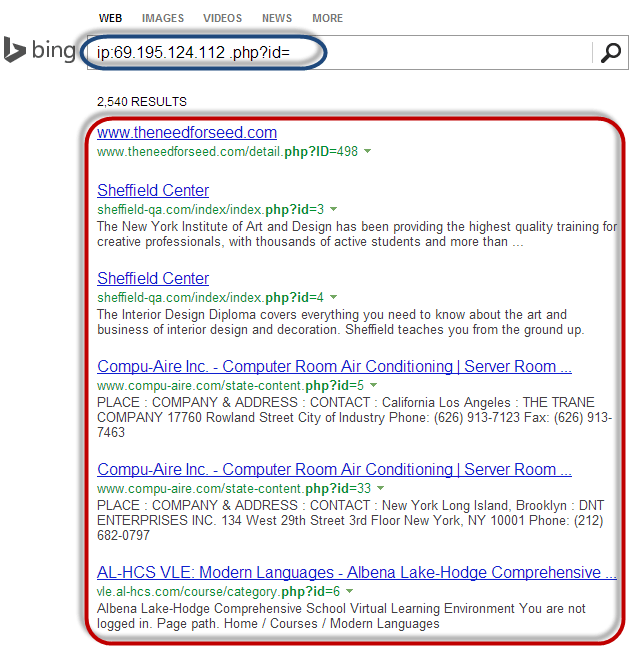
Enter the URL www.bing.com into your web browser. This will only work with bing so don’t use other search engines such as google or yahooEnter the following search query

ip:69.195.124.112 .php?id=

HERE,

“ip:69.195.124.112” limits the search to all the websites hosted on the web server with IP address 69.195.124.112“.php?id=” search for URL GET variables used a parameters for SQL statements.

You will get the following results

As you can see from the above results, all the websites using GET variables as parameters for SQL injection have been listed.

The next logic step would be to scan the listed websites for SQL Injection vulnerabilities. You can do this using manual SQL injection or using tools listed in this article on SQL Injection.

Uploading the PHP Shell

We will not scan any of the websites listed as this is illegal. Let’s assume that we have managed to login into one of them. You will have to upload the PHP shell that you downloaded fromhttp://sourceforge.net/projects/icfdkshell/

Open the URL where you uploaded the dk.php file.You will get the following window

Clicking the Symlink URL will give you access to the files in the target domain.

Once you have access to the files, you can get login credentials to the database and do whatever you want such as defacement, downloading data such as emails etc.

Summary

Web server stored valuable information and are accessible to the public domain. This makes them targets for attackers.The commonly used web servers include Apache and Internet Information Service IISAttacks against web servers take advantage of the bugs and Misconfiguration in the operating system, web servers and networksPopular web server hacking tools include Neosploit, MPack and ZeuS.A good security policy can reduce the chances of been attacked